
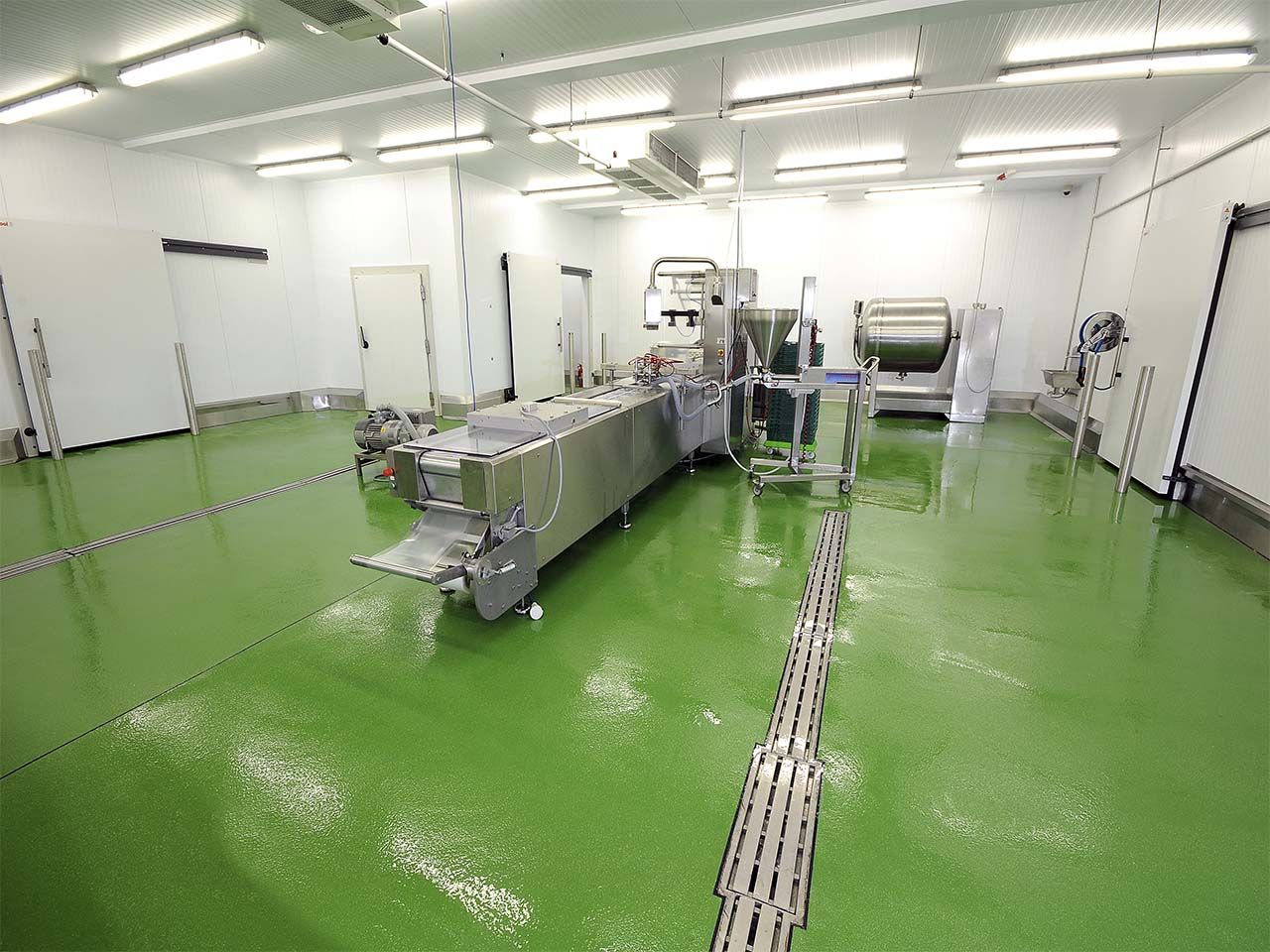
Polymer flooring systems are used in a wide range of industrial sectors, including the food industry. Since food production facilities manufacture consumable goods, their floors must comply with all sanitary and hygienic standards, as well as regulations such as SNiP, GOST, and others. A properly selected flooring system ensures compliance with these requirements.
Features of flooring for the food industry
High demands are driven by continuous exposure to aggressive substances generated during production. The floor surface must be seamless and level to prevent dirt accumulation and bacterial or fungal growth. Floors are also subject to mechanical loads and temperature fluctuations.
Sterility is a key requirement; therefore, wet cleaning and steam cleaning are commonly used.
Types of flooring for the food industry
Polymer systems:
- polyurethane-cement flooring
- epoxy flooring
- polyurethane flooring
Polyurethane-cement flooring
This type is ideal for food industry facilities requiring chemical resistance, slip resistance, and high wear resistance. Operating temperature ranges from -40°C to +120°C.
Systems offered: Flowfresh SR, Flowfresh MF, Flowfresh HF, Flowfresh RT – specifically designed for the food industry with antimicrobial additive content.
Epoxy flooring
Epoxy resin flooring systems are highly resistant to moisture, acids, alkalis, and other chemical substances, making them suitable for production areas with wet processes or high humidity environments.
For food industry facilities, we offer epoxy systems: Flowcoat SF41 and Peran STB Compact with quartz filler.
Polyurethane flooring
Polyurethane flooring systems withstand high mechanical, impact, and vibration loads. They are commonly used in production areas with heavy equipment.
For food industry facilities, our experts recommend the Flowshield LXP system.
Advantages of polymer flooring in the food industry
An increasing number of manufacturers choose polymer floors as an essential element of modern food production facilities. Industrial polymer flooring offers the following characteristics and benefits:
- resistance to all types of loads
- chemical resistance to food ingredients used in production
- seamless and monolithic structure
- antibacterial properties – Flowfresh polyurethane-cement floors contain Polygiene silver-ion technology, reducing up to 99.9% of microorganisms on the surface
- resistance to high and low temperatures and thermal fluctuations
- moisture resistance and slip-resistant properties for safe movement of personnel
The main advantage is long service life and the possibility of fast renovation, making it a cost-effective solution.
Where polymer floors are used
- bakeries and confectionery production
- meat processing industry
- fish processing industry
- alcoholic and non-alcoholic beverage production
- dairy industry
- semi-finished food production
- tobacco industry
- flour and grain processing plants
You can view completed projects in the “Projects” section.