
With the growing population of large cities and metropolitan areas, the demand for additional parking spaces is also increasing. To address this issue and provide convenient parking near residential buildings, shopping and business centers, the construction and renovation of parking lots, car parks, and large garage complexes is carried out on an ongoing basis.
Modern parking construction is a highly technological process, requiring professional construction equipment, high-quality certified materials from international manufacturers, strict adherence to standards and technologies, and the involvement of experienced specialists. Special attention is paid to flooring systems, as they bear the main loads.
A key feature of garage and parking flooring is that the most heavily loaded areas are entrances and exits, while parking bays experience lower stress. Therefore, these high-load zones must be significantly reinforced.
General requirements for parking flooring
Requirements depend on the size and type of facility, but there are common criteria:
- high strength and abrasion resistance (vehicle tyres, sand and gravel)
- high chemical resistance to automotive fluids and aggressive substances
- moisture resistance (both underground and open parking areas)
- dust-free surface and easy maintenance
- frost resistance and resistance to temperature fluctuations
- aesthetic appearance and user comfort, especially in commercial and business centers
Types of flooring for parking lots and car parks
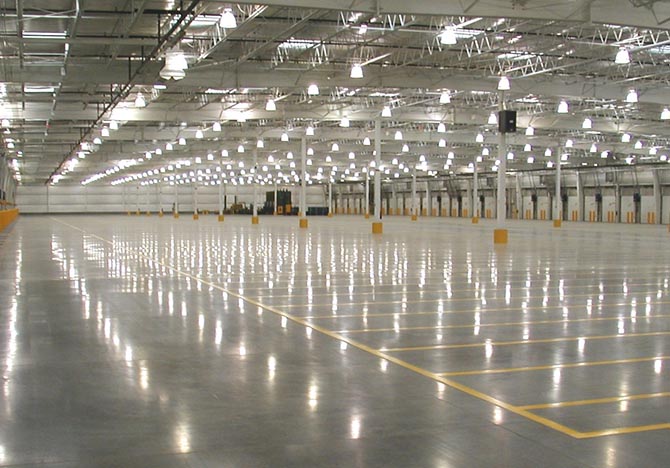
As mentioned earlier, the most popular and reliable flooring solutions for parking areas are reinforced concrete floors and resin-based polymer floors. No other flooring type can match their technical performance.
Concrete flooring for parking areas
Concrete floors are an optimal choice when aesthetics and design are not a primary concern.
Concrete floors in parking areas are installed using a dry-shake hardener (topping), which strengthens the surface and reduces dusting. In high-load zones such as turning areas and entrances, the topping layer must be thicker. Polymer impregnations are also used to reinforce the surface.
The thickness of a concrete floor depends on the type and intensity of loads. For private parking areas with 1–2 vehicles, thick slabs are not necessary.
Concrete bases are used as a foundation for any flooring type, including resin systems. They can be monolithic slabs, foundations, or screeds. Concrete offers good resistance to UV radiation, moisture, and chemicals. Its main advantage is cost efficiency.
Resin flooring in parking areas
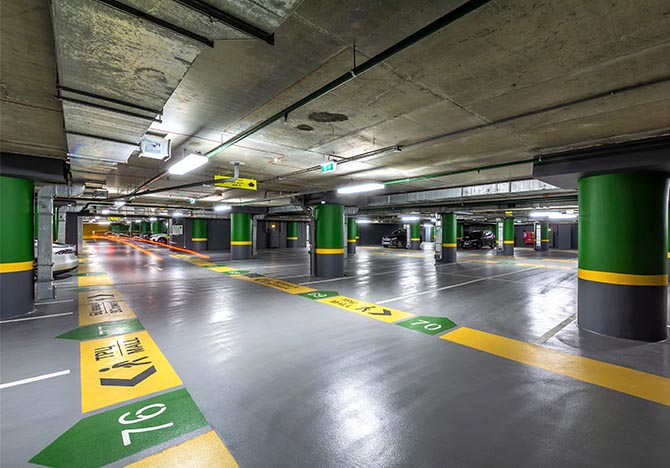
In the past, concrete floors were commonly used, but today they are increasingly replaced by resin systems due to their comfort, durability, and aesthetics.
Resin floors are seamless, preventing bacterial accumulation (which is why they are also widely used in the food industry). They are fire-resistant and non-toxic.
These floors perform well with vehicle tires in all weather conditions. They can be made anti-slip by adding quartz sand. They are resistant to moisture and temperature fluctuations.
Polyurethane systems are most commonly used for parking applications because they offer the highest load resistance, do not crack, and maintain performance over long periods. They also provide excellent chemical and UV resistance.